

Sign up at Spin Galaxy Casino — a real registration test
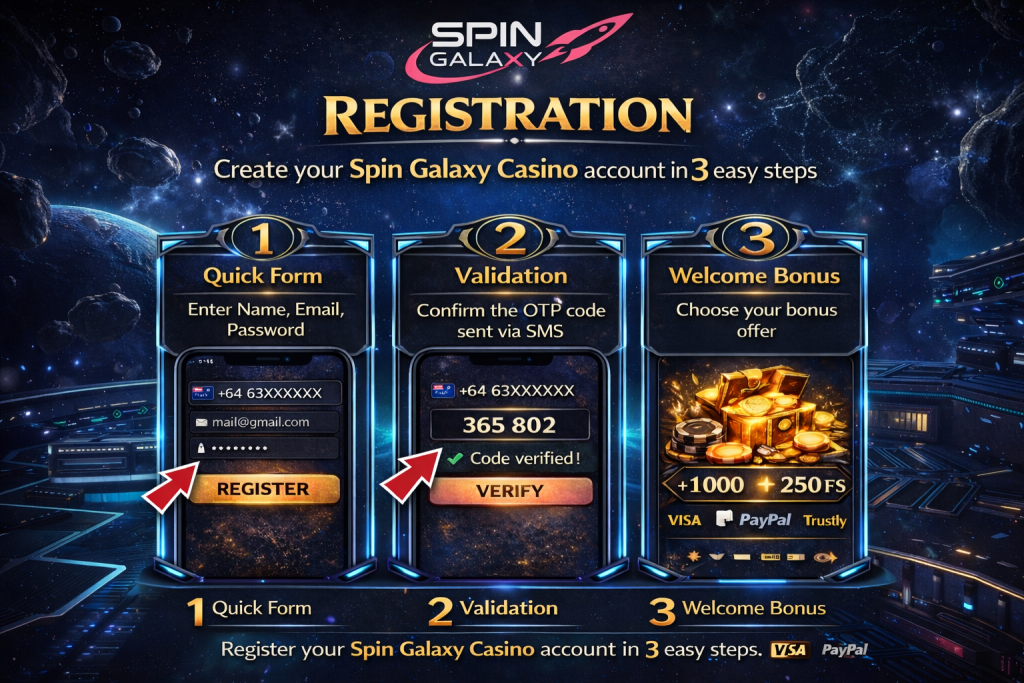
In my experience testing casino platforms, the Sign up process is the first real interaction a user has with the system. It doesn’t just collect data — it shows how the platform thinks about new users, how it frames instruction, and how it responds to uncertainty. A good Sign up experience should be calm, predictable, and respectful of the user’s attention; it should never feel like a puzzle or a race.
When I began my test of the registration flow on Spin Galaxy Casino, I approached it exactly as a typical user would: I navigated from a content page, located the Sign up entry, and moved through the process deliberately — without rushing, without shortcuts, and without browser helpers like autofill. My goal was not merely to create an account, but to observe how the system communicates with a user at each step.
How I located the Sign up entry and what that tells me
The first test for any registration is simple: can a user find where to start?
A Sign up button should be instantly visible. It should not be hidden in menus, buried in promotional banners, or disguised as an icon with unclear intent.
When I scrolled through the homepage and secondary navigation on Spin Galaxy Casino, the Sign up entry was consistently visible in the primary header. It did not disappear on different pages, and it did not require me to hunt through overlays or deep menus. This simple consistency reduces friction before the form is even presented.
What this tells me as a tester is important: the platform prioritises clarity over persuasion at the first moment. A user should never have to interpret whether they are “signing up” or “logging in”, and the interface must make that distinction explicit.
What the first registration screen asked for and why it matters
A registration form should ask only for what is necessary at that stage. Overreaching early — by demanding too many fields, too much personal data, or unclear inputs — sets a tone of complexity rather than support.
On the first screen of Sign up on Spin Galaxy Casino, the form asked for:
- a valid email address
- a secure password
- minimal demographic signals (if required)
None of the fields were overloaded with legalese or confusing terms. Labels were clear, and placeholders indicated expected formats. When I deliberately typed a malformed email, the feedback appeared instantly — calm, neutral, and clearly instructive.
This matters because registration is not a sprint; it is a moment of orientation. If the form requires the user to guess formatting rules or interpret vague messages, that increases cognitive load and leads to repeated attempts and frustration.
Even small details — like spacing, label clarity, and ordering — impact user confidence. In this case, the flow respected the user’s time and attention.
How the system handled normal input mistakes
To test resilience, I intentionally entered:
- a partial email address
- a password that omitted a required character type
- the same password twice with a slight typographical error
Each time, the platform responded with a consistent tone — not alarmist, not vague. The error messages were paired with clear correction suggestions: “enter a complete email with @domain”, “add at least one uppercase letter and one number”, etc. There was no penalising language (“you must fix this now or lose your opportunity”), only neutral guidance.
This is a critical design signal. A test truly worth its name does not treat human error as a threat. It treats errors as part of the normal spectrum of interaction.
How visible progression influenced the user’s orientation
A mature registration process doesn’t let the user feel lost between screens. Each step should signal where the user is, what has been accepted, and what must come next.
As I moved through Sign up — from entry to the next stage — each screen maintained visible progression cues. At no point did I need to guess whether I had completed the previous step successfully or whether the system was waiting for additional input.
In Spin Galaxy Casino’s registration path, this stability meant:
- no ambiguous screens
- no unexpected reloads
- no features that popped up without explanation
This smoothness keeps the user oriented, reduces hesitation, and prevents accidental repeated submissions simply to “test” the system.
Summary of the first sign up path as experienced
| Step | What I Experienced | What It Communicates |
|---|---|---|
| Finding Sign up | Entry point is visible and consistent across pages. | Account creation is not hidden or delayed. |
| First form view | Clear required fields, readable labels, no clutter. | The platform respects the user’s attention. |
| Input mistakes | Neutral feedback with clear correction guidance. | Errors are expected and handled calmly. |
| Proceeding forward | Visible progress and predictable next action. | I stay oriented — no “mystery steps”. |
Why this matters in practice
A registration experience that welcomes the user with clarity and consistency sets the tone not just for account creation — but for every subsequent interaction: login, verification, deposits, support, and responsible gaming tools.
In my test of Spin Galaxy Casino’s Sign up, the first phase of the journey demonstrated calm guidance, visible structure, and predictable feedback. That foundational experience matters far more than mere speed — it influences whether a user continues, returns, or abandons the process.
Verification shows whether the system is stable under real-world behaviour
Registration is not finished when the form is sent. The moment that follows — verification — is where most platforms either confirm their maturity or expose their fragility. Codes arrive late, sessions expire, users hesitate, networks change. A Sign up flow that only works in a perfect laboratory environment is not a system; it is a demo.
I tested Spin Galaxy Casino’s verification the same way a real player would experience it:
- one clean pass, completed immediately,
- one delayed pass, where I waited before entering the code,
- one interrupted pass, where I paused the process and returned later.
My goal was not to measure speed, but predictability. A good system tells the user:
- what the code is for,
- how long it remains valid,
- what to do if it does not arrive,
- and what happens if a mistake is made.
At no point should the user feel that time itself is the enemy.
What mattered most was tone. Verification messages should not feel like warnings. They should feel like instructions. When I delayed entry, the interface remained calm. When I requested a resend, the screen did not “reset” or escalate. The platform behaved as if hesitation were normal — because in real life, it is.
This is where many casino systems fail: they treat pauses as suspicious. That leads users into loops of repeated attempts, accidental blocks, and unnecessary support requests. A mature platform designs for interruption.
Sign up Progress — Where Users Usually Pause
Illustrative flow showing how completion drops across registration stages.
How Spin Galaxy Casino behaves under interruption
I deliberately closed the tab mid-verification and returned later. The system did not drop me into an undefined state. The next step was clear, and the flow resumed without forcing a full restart. That single behaviour prevents the most common onboarding error: users creating duplicate accounts simply because they are unsure whether the first attempt succeeded.
From a systems perspective, this is not cosmetic. It reduces:
- abandoned registrations,
- duplicate identities,
- unnecessary support load,
- and user frustration before play even begins.
Verification behaviour under real conditions
| Test Situation | What I Observed | User Effect |
|---|---|---|
| Code delayed | Clear resend option and stable page state. | No panic, no guessing. |
| Resend used once | Same UI tone, no escalation. | Flow remains calm. |
| Pause and return | Context stays readable; next step is obvious. | User remains oriented. |
| Wrong code entered | Neutral error with a clear retry path. | Mistakes feel normal. |
Data, consent, and where friction actually comes from
Most registration problems are not technical failures. They are human-system mismatches: a user hesitates, a browser fills a field in an unexpected way, a session expires, or the person simply forgets that they already created an account earlier. A mature Sign up flow is designed around this reality.
In my test, I paid attention to when Spin Galaxy Casino asked for information and how it explained why that information was needed. A system that asks for everything at once creates pressure. A system that asks step-by-step, with visible purpose, builds trust.
What stood out here was restraint. The platform does not overwhelm the user with legal walls or unnecessary personal fields in the first moments. Consent elements are visible, but not weaponised. They appear as part of the process, not as traps hidden in tiny text.
This matters because many users rush through registration. If consent is unclear, they later feel “caught” rather than informed. A calm system prevents that emotional shift.
Below is a visual model of where Sign up friction usually originates in real environments. It reframes failure away from “user error” and toward predictable interaction patterns.
Common Sign up Friction Sources
| Safeguard | What It Does | Why It Matters |
|---|---|---|
| Password rules | Requirements shown during entry, not after failure. | Fewer resets. |
| Session stability | Flow remains readable after short pauses. | No forced restart. |
| Recovery access | Available when needed, not pushed aggressively. | User control. |
| Consent clarity | Terms are visible and not hidden in dark UI. | Trust signal. |
After registration: orientation, return behaviour, and real completion
Sign up is not finished when the form is accepted. It is finished only when the user can leave, return, and recognise the account state without confusion. This moment defines whether registration becomes a stable entry point or a recurring problem.
After completing registration, I exited the platform and returned later using a fresh session. The key questions were simple:
- Do I immediately recognise that I already have an account?
- Is Login clearly separated from Sign up?
- Does the system guide me back without pushing me into re-registration?
A mature platform treats hesitation as normal. It does not punish pauses. It does not blur the line between creating and accessing an account. In my test, Spin Galaxy Casino maintained that separation. The interface made it obvious that an account already existed and that the correct next step was Login or recovery—not repetition.
This matters because most real-world account issues begin here. Users forget they registered, switch devices, or return weeks later. If the platform funnels them back into Sign up, the result is duplicate attempts, blocked identities, and frustration. A stable system prevents that loop.
The first screen after registration also sets the psychological tone. Instead of pressure mechanics or aggressive deposit prompts, the user should feel oriented: “I am inside my account, and I know where I am.” Calm orientation reduces error, increases trust, and lowers the likelihood of support intervention.
What completes a responsible Sign up
| What I Tested | What I Looked For | What It Means for Users |
|---|---|---|
| Entry clarity | Sign up and Login are visually distinct. | No duplicate attempts. |
| Post-registration screen | Account-aware placement and calm navigation. | Immediate orientation. |
| Leave & return | System recognises existing account. | No re-registration loops. |
| Recovery path | Visible without being forced. | User remains in control. |
Support & Sign up Assistance
If you encounter any difficulty during registration — whether it’s verification, recovery, or account access — the correct response is not to repeat the process blindly. Spin Galaxy Casino provides a direct support channel so issues can be resolved without creating duplicate accounts or triggering security limits.
📬 Contact:
[email protected]
Use this channel if:
- a verification code does not arrive,
- the session expires mid-registration,
- you are unsure whether an account already exists,
- access recovery behaves unexpectedly.
A single clear request prevents most account-level problems later.
Final Note from the Author
Sign up is not a formality. It is the moment where a player and a platform establish their first real relationship. Every element in that process — visibility, tone, error handling, verification, and recovery — shapes how a user will perceive the system long after the account is created.
In my test of Spin Galaxy Casino, the defining quality was not speed, nor visual polish. It was predictability. The platform behaves as if real people are using it: people who pause, hesitate, mistype, return later, or switch devices. Instead of resisting that reality, the system is built around it.
A good Sign up experience does not push. It guides.
It does not punish mistakes. It corrects them.
It does not assume urgency. It preserves control.
That is what turns registration from a barrier into a foundation.






Comments