

Login in Spin Galaxy Casino — a real system test
My name is Jarrod True. I test casino platforms the same way I read regulatory systems — by observing how they behave when a person hesitates. Login is not a decorative step. It is the first real interaction between the user and the system. It shows whether the platform is built to calm behaviour or to accelerate it.
I do not approach login as a technician. I enter as a normal player. I arrive from a content page. I pause. I look for where access truly begins. I type my details once, without rushing, and I wait for the system to answer. I am not looking for speed. I am looking for clarity.
Spin Galaxy Casino treats login as a visible process. Nothing happens in silence. Every step is understandable. That is the foundation of a responsible gateway.
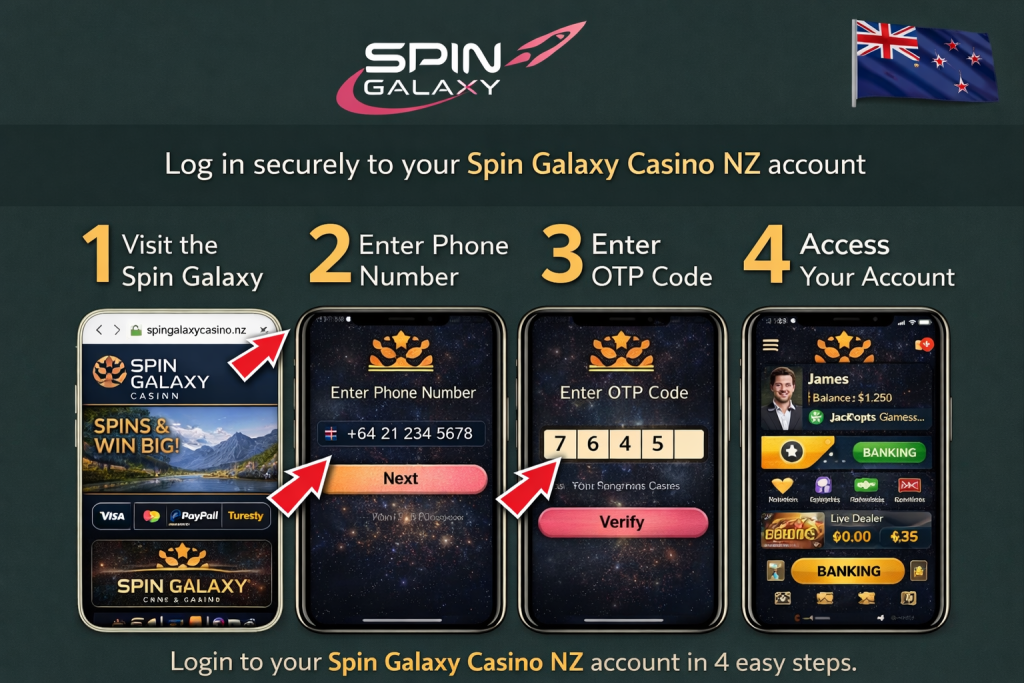
How I actually enter the platform and what the system shows me
I begin on an ordinary page. I am not “in account mode”. When I decide to enter, I do not search. The login entry point is where it should be. It is stable across the site and not hidden behind banners or overlays. One click opens a space that clearly belongs to access, not promotion. This already sets the tone: the platform separates identification from persuasion.
I enter details and watch how the system reacts
I type my credentials slowly and submit once. The form reacts immediately. There is no empty pause. I do not wonder whether the click worked. I do not feel the need to press again. The system shows that my action has been received. That single behaviour prevents most unsafe habits users develop during login: double clicks, retyping, or abandoning the form mid-process.
I make a mistake and observe the tone
I intentionally enter the wrong password. The message appears. It is calm and clear. I repeat the same mistake. The message is identical. The form does not reset. Nothing escalates. The platform does not behave as if I am doing something suspicious. It behaves as if mistakes are normal. That stability keeps behaviour slow and deliberate.
I enter correctly and see where I am
When I finally submit the correct details, the transition is visible. The interface reflects that I am now inside my account. I do not have to test it by clicking something risky. I know where I am. The system places me with context.
| Step | What I Experienced | What It Communicates |
|---|---|---|
| Finding Login | Entry point is visible and stable. | The platform does not hide access. |
| Submitting Form | Immediate visual response. | The system acknowledges my action. |
| Making an Error | Calm, consistent message. | Mistakes are expected, not punished. |
| Successful Entry | Clear account-aware placement. | I know exactly where I am. |
How I test retries, recovery, and behaviour under stress
A login system is not defined by the perfect path. It is defined by what happens when something goes wrong. That is why I always test the second and third attempt. I do not rush. I do not paste. I behave the way a tired user behaves in the evening.
After the first incorrect entry, I pause. I read the message. I do not immediately try again. I want to see whether the system waits with me or pushes me forward. In Spin Galaxy Casino, nothing changes in tone. There is no countdown. No visual pressure. The form remains exactly where it was. The system does not “lean” toward me.
That matters. Many platforms begin to signal urgency after the first error. They change colour, wording, or layout. This subtly teaches users that something is wrong with them. Here, the platform keeps the same posture. It communicates that mistakes are part of the process.
I repeat the same mistake on purpose
I enter the same wrong password again. I want to see whether the system escalates emotionally. It does not. The message is identical. The form does not jump. No additional warnings appear. The interface does not imply danger.
This is one of the most important design decisions in a gambling-adjacent environment. A platform that becomes “nervous” teaches the user to become nervous. Nervous users rush. Rushing leads to unsafe shortcuts. Here, the system remains neutral. It does not mirror anxiety.
I look for recovery without being pushed into it
After two failed attempts, I do not change my behaviour. I simply observe whether the platform starts steering me aggressively toward recovery. A responsible system does not hide recovery, but it also does not weaponise it.
On Spin Galaxy Casino, the recovery path is visible and stable. It is present, but it does not dominate. I am not forced into it. I am not told that “something is wrong with my account”. The system lets me decide when to use it.
That balance is rare. Many platforms either bury recovery or shove it in front of the user too early. Both approaches teach bad habits: either users abandon accounts or they abuse recovery as a shortcut.
I enter the correct details after hesitation
When I finally enter the correct password, there is no penalty for the delay. I am not asked to “prove” myself. I am not redirected into verification flows. The system behaves as if nothing abnormal happened.
This is what responsible access looks like:
the platform does not remember hesitation as guilt.
| Test Situation | What I Observed | Behavioural Effect |
|---|---|---|
| First incorrect entry | Neutral message with no change in tone. | The user remains calm and deliberate. |
| Repeated mistake | Identical feedback without escalation. | No pressure to rush or overreact. |
| Recovery visibility | Recovery option is present but not dominant. | The user keeps control of the flow. |
| Successful login after delay | No penalty, no suspicion, no extra friction. | Hesitation is treated as normal behaviour. |
Stability of Login Response Across Attempts
Login response stability across repeated attempts
Illustrative measurement of system response time (seconds) across six consecutive login attempts.
How the session behaves after login and why this matters more than speed
A login test does not end at the moment of entry. It ends when I understand how the session behaves once I am inside the system. The real question is not “Did I get in?” but “Does the platform now behave as if it knows who I am?”
After logging in to Spin Galaxy Casino, I move slowly. I refresh the page. I navigate to another section. I open a different category. I want to see whether the system remains coherent or whether it quietly forgets me.
The signal I am looking for is continuity. A responsible platform does not make me wonder whether I am still logged in. It does not switch state silently. It does not drop me into a neutral mode without explanation. Every transition should preserve context.
Here, the session feels stable. Navigation does not trigger unexpected logout. Refreshing the page does not reset my state. I am not forced to “prove” myself again after ordinary actions. The platform behaves as if my presence is legitimate and continuous.
I test how the system handles interruption
Real users do not stay in one uninterrupted flow. They switch tabs. They pause. They return. They lose network for a moment. A login system must survive those conditions without creating confusion.
I leave the page for a short time and return. I reload. I move between sections. The session remains intact. When a session does end, it ends cleanly. I am not left in a half-state. The system does not pretend that I am inside while quietly treating me as outside.
This matters because silent session loss is one of the most destructive patterns in gambling environments. It leads users to repeat actions, re-enter forms, and test boundaries. It teaches them to click until something happens.
Spin Galaxy Casino avoids that pattern. State changes are visible. When the system no longer recognises me, it shows it. When it does recognise me, it behaves consistently.
Where login friction usually comes from
Illustrative distribution of the most common causes behind failed or repeated login attempts.
I watch for “hidden pressure” inside the session
Some platforms use the logged-in state to quietly accelerate behaviour. They add prompts, overlays, or urgency cues immediately after entry. That moment is psychologically sensitive. The user has just crossed a boundary.
Here, nothing rushes me. There is no sudden call to act. No visual pressure. No artificial momentum. I am simply inside. The system does not interpret my presence as readiness.
That distinction matters. A responsible login experience does not treat access as consent to act. It treats it as identity, nothing more.
| Session Check | What I Observed | User Effect |
|---|---|---|
| Page refresh | Account state remains visible and consistent. | No uncertainty about being logged in. |
| Navigation across sections | No silent logout or state loss. | Behaviour stays deliberate. |
| Short interruption | Session survives ordinary pauses. | User does not repeat actions. |
| Session end | Logout is clean and visible. | No half-states or confusion. |
What a responsible login system looks like in a gambling environment
At this stage, I stop thinking like a user and return to thinking like an analyst. The question becomes simple: does this login flow merely allow entry, or does it actively shape behaviour in a healthy way?
In gambling-related systems, access is power. The moment a user enters, the platform can either:
- slow them down,
- or silently accelerate them.
A responsible login system does not confuse identity with intent. Logging in does not mean “I am ready to play”. It means only “this is me”. Spin Galaxy Casino respects that boundary. Entry does not trigger urgency. It does not reinterpret presence as willingness to act. The system remains neutral.
That neutrality is rare. Many platforms treat login as the start of momentum. They attach prompts, banners, or calls to action immediately after entry. This platform does not. It allows the user to arrive before being asked to decide.
I look for whether safety is built into the flow, not added later
True responsibility is not a banner at the bottom of a page. It is behaviour embedded into the system. In this login flow, safety appears as:
- visible state changes,
- stable error handling,
- non-escalating tone,
- predictable recovery,
- calm session behaviour.
None of these elements announce themselves as “responsible design”. They simply exist. They shape how a person moves through the gateway.
The system does not rely on the user being disciplined.
It creates conditions where discipline is natural.
I apply a simple standard when I judge a login flow
A login system is reliable when it:
- never makes the user guess what happened,
- never punishes hesitation,
- never treats mistakes as threat,
- never turns access into momentum,
- never hides state changes.
This is the checklist I apply:
| Design Principle | What It Prevents | Why It Matters |
|---|---|---|
| Visible system states | Guessing and repeated actions | Users stay deliberate. |
| Stable error handling | Panic retries and rushing | Mistakes remain neutral events. |
| Non-escalating tone | Emotional acceleration | The system does not mirror anxiety. |
| Controlled recovery paths | Account abuse and shortcuts | Safety without obstruction. |
| Neutral post-login state | Impulse-driven actions | Access is not pressure. |
Closing note from the tester
When I finish testing a login system, I ask myself only one question: Did this platform make it easy for me to remain in control?
Spin Galaxy Casino’s answer is quiet but clear. The system does not rush me. It does not confuse me. It does not reinterpret hesitation as weakness. Every step is visible, every state is understandable, and every mistake is treated as a normal part of human behaviour.
A login flow like this does not “pull” the user inside. It lets the user enter. That difference is subtle, but it defines everything that follows. Where access is calm, decisions remain deliberate. Where the gateway is stable, the player remains the one who chooses.
That is what I look for in a responsible platform.






Comments